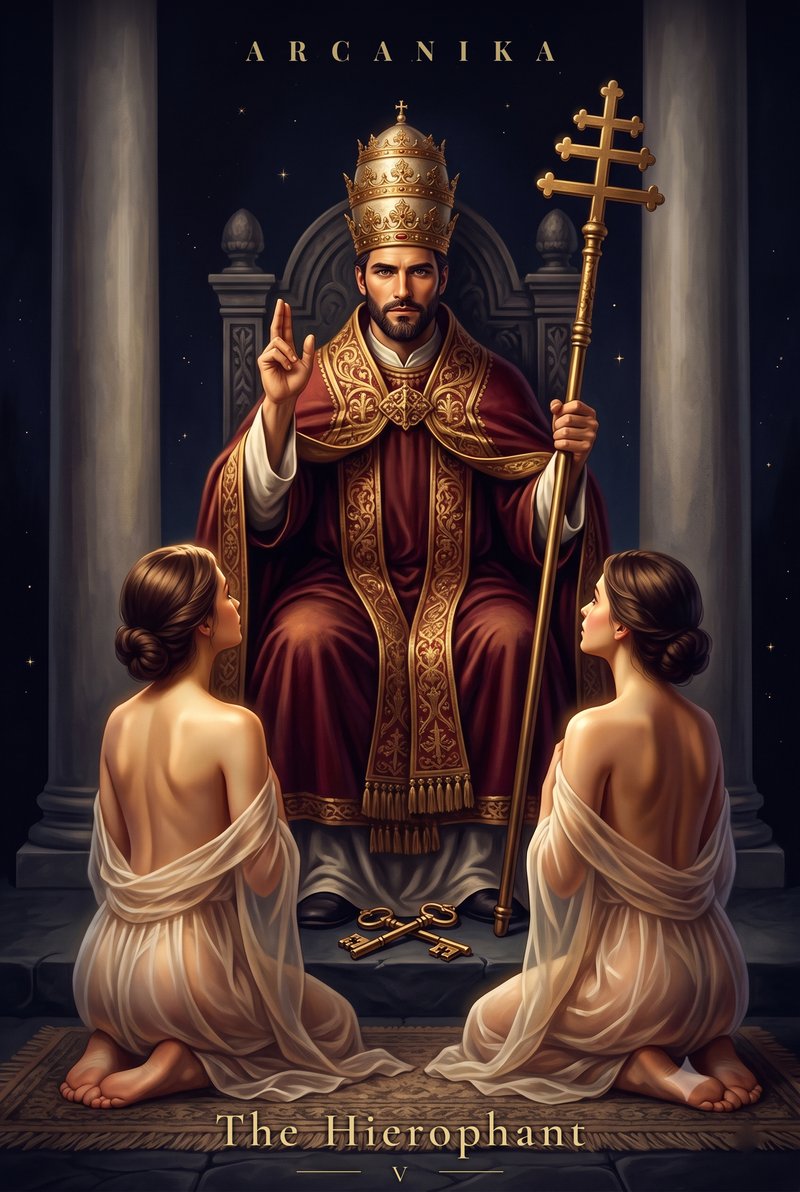
On a throne between smooth columns sits the Hierophant in rich vestments and a tall crown, with a cross-staff and a hand lifted in blessing. But at his feet are not the meek attendants of tradition — they are two young novices, kneeling with their backs to us: thin garments have slipped from their shoulders, baring naked backs and the line of their hips, their heads bowed in submission and waiting. This is no cold sermon but a living initiation: knowledge passed not through words but through trust, closeness, a readiness to bow before the one who leads. The Hierophant is about tradition, mentorship, spiritual authority; about rites and foundations that bind people together. Here the sacred and the sensual turn out to be one: the path to the higher runs through the body and through the willingness to place oneself in the hands of one who knows. In the figure of the teacher there is the calm charisma of one who is believed and followed, and in the bowed pupils, the sweet humility of apprenticeship, which holds its own deep eroticism. The rite is only beginning, and both of them know: what comes next is revelation.
👑Triple Crown — Three tiers of authority — earthly, purgatorial, celestial — and three aspects of human experience brought under the canopy of doctrine. The crown is also a kind of antenna: it reaches toward what is above and channels it downward into form.
✝️Triple-Cross Staff — The papal scepter, symbol of dominion over all three worlds. He holds authority not by conquest but by transmission — the staff is a channel, not a weapon.
🗝️Crossed Keys — The keys of binding and loosing — what the tradition opens and what it locks. A key is both liberation and limit: it grants entry to those who belong, and keeps out those who do not yet carry the code.
🤲Blessing Gesture — Two fingers raised, two lowered — the ancient division of exoteric (the public teaching) from esoteric (what lies beneath). He blesses openly; the deeper mystery is gestured toward but not spoken.
🏛️Gray Pillars — Unlike the black and white pillars of The High Priestess, these columns bear no inscription and hold no veil. This is the outer temple — solid, neutral, reliable. The mystery is the man between them, not the architecture.
👥Two Acolytes — The tradition requires receivers to exist. Without those who kneel and listen, the Hierophant is merely a man in a chair. The acolytes remind us that knowledge only lives when it passes from one person to another.
Interpretation
The Hierophant occupies the fifth position in the Major Arcana, and he marks the third great step in a sequence of social formation: after the raw abundance of The Empress shapes a person through nature, and the structured authority of The Emperor shapes them through law, the Hierophant shapes them through meaning. He is the moment when a human being is handed not just rules but a story — a framework for why things are the way they are, and what they are ultimately for.
In the arc of the Major Arcana, the Hierophant sits in necessary tension with The High Priestess. She is the hidden face of sacred knowledge — silent, interior, veiled; he is its public face — spoken, ceremonial, transmitted through institution. One holds the mystery, the other gives it a grammar. Neither is complete without the other, and a reading that calls forth both often describes someone standing between private knowing and public form, wondering how to bring the two together.
In practical readings, the Hierophant often signals that the right move is to work within a system rather than against it — to find the teacher, follow the method, earn the credential, or honor the ritual. This is not capitulation; it is the recognition that some knowledge cannot be invented alone. It has to be received. The card appears when a tradition holds something genuinely useful for you, even if the packaging looks conventional or constraining.
When the Hierophant appears alongside The Devil, the combination can illuminate how any teaching, once it stops serving the student's growth, becomes a chain. The Devil is sometimes called the dark mirror of the Hierophant: the same gesture of blessing, the same two figures at his feet — but the dynamic has inverted from transmission to bondage. And when the Hierophant sits near The Hanged Man, something remarkable is suggested: the tradition has done its work, and the seeker is now ready to suspend everything they were taught in order to see from the inside.
✦ Full InterpretationUnlock the card's full readingFree registration reveals the final paragraphs of the interpretation and gifts you ⭐ for your first spreadyour first spread is on us
Advice & forecast
✦ The card's advice
When the Hierophant appears for you, something structured is asking to be honored — a body of knowledge, a method, a teacher, a ceremony. The impulse to go your own way is not wrong, but this is not the moment for it. There is something in the established path that you have not yet fully received, and leaving too soon means carrying away half a map. Find the person who has walked this ground before you and ask your real questions. If no such person is available, find the texts, the lineage, the practice that holds the tradition alive. Receive it seriously, not as a follower, but as someone who knows that a language must be learned before it can be spoken with your own accent.
🔮 What the forecast holds
Ahead there is a formalization — something becoming official, blessed, or sanctioned. This could be a commitment in love, a professional qualification, an institutional affiliation, or a ceremony that marks a passage. The Hierophant in the future position does not promise that what is coming will be thrilling; it promises that it will be solid. Something is being made real in a way that will last. There may also be an encounter with an authority figure — a mentor, an elder, an institution — whose guidance will shape the period ahead. Approach this encounter without either blind obedience or reflexive resistance: there is something genuinely valuable being offered.
↓ The Hierophant reversed
When the Hierophant is reversed, the question of authority becomes tangled. On one end, the card can show someone who has swallowed a tradition whole — who repeats its formulas without ever having tested them, who uses the language of belief as a way to avoid the discomfort of thinking. The doctrine has become the person; there is no gap between what they were told and what they actually experience. This is a comfortable prison, and it is also one that can be invisible from the inside. On the other end, the reversed Hierophant can show someone who has declared war on all tradition, all structure, all received wisdom — who mistakes nonconformity for freedom and discovers, eventually, that they have only traded one cage for another. The real invitation of the reversed card is not to surrender to the tradition and not to overthrow it, but to find your own honest relationship to it: to take what is genuinely nourishing, acknowledge what was harmful, and stop letting the whole edifice define you by your stance toward it. The first step is simply noticing which way the blockage runs — toward too much structure, or too little.
The card in spreads
The same card reads differently depending on the spread and the question — compare real spreads:
Spread "The Teacher and the Student"
Understanding a mentorship, guidance relationship, or learning path
«What is being transmitted to me, and how should I receive it?»
What is hidden — the esoteric dimension of the teaching
The High Priestess
The teaching itself — what tradition or structure is at work
The Hierophant
The choice — what you do with what you receive
The Lovers
Read the first card — The High Priestess in position — as the silent, inner layer of what is being offered: the thing beneath the doctrine, the knowing that precedes the words. The Hierophant in the center names the form of the transmission: this might be an institution, a mentor, a canon of practice, or a ceremony. Notice whether the Hierophant appears upright or reversed — upright asks you to receive fully; reversed asks you to examine what you are actually being given before accepting it wholesale. The third card, in the position of The Lovers, reveals the choice that emerges from this encounter: not just a decision about the tradition, but a deeper choice about who you are becoming through it. Together, these three ask: what is the tradition teaching you that you cannot learn alone, and once you have received it, what will you make of it?
Spread "Form and Mystery"
Navigating between structure and inner knowing
«Where do I need more structure, and where do I need more freedom?»
The outer law — what structure or authority is operating
The Emperor
The transmission — what meaning or tradition is being offered
The Hierophant
The inner reversal — what changes when you surrender to it or let it go
The Hanged Man
The first card — The Emperor — shows the worldly structure around the situation: the institution, the rule, the hierarchy. The Hierophant in the center speaks to the meaning within that structure — is it genuine transmission, or empty form? Pay close attention here to tone and surrounding energy. The final card — The Hanged Man — reveals what happens when the form is truly accepted: not passive compliance, but the radical interior shift that can come from fully receiving a tradition. Sometimes what looks like surrender is actually the preparation for a completely new way of seeing. This spread is especially useful when you are deciding whether to commit to a path, a practice, or a formal relationship — not whether the structure is perfect, but whether it holds something that can genuinely change you.
✦ PremiumUnlock the Full ReadingSpread "Form and Mystery": position-by-position reading, card combinations, and guidanceOpen with subscription →first spread is free
Spread "Blessing and Binding"
Understanding where tradition serves and where it constrains
«What is this structure liberating me into, and what is it locking me out of?»
The tradition — what is being offered or imposed
The Hierophant
The shadow — where this structure becomes a chain
The Devil
The inner guide — what you know that the tradition cannot tell you
The Hermit
The Hierophant opens this spread as the structure in question: a religion, a relationship contract, a professional canon, a family system. Hold it as a real thing with real weight — do not rush past it. The Devil in the second position names the shadow of this particular structure: the place where the teaching has curdled into control, where the blessed container has become a cage. This is not an indictment of the whole tradition, but a precise locator of what within it no longer serves. Finally, The Hermit in the position of the inner guide speaks to what you already know — the light you carry independently of any institution. When these three are read together, they map the full territory: what the tradition genuinely offers, what it costs, and what sovereign knowing you bring to the encounter. The question this spread ultimately asks is not whether to accept or reject — it is how to stand inside a structure with your eyes open.
✦ PremiumUnlock the Full ReadingSpread "Blessing and Binding": position-by-position reading, card combinations, and guidanceOpen with subscription →first spread is free
How it differs from Manara
Rider-Waite-SmithThe Hierophant
vs
Soblazn — Sensual TarotThe Hierophant
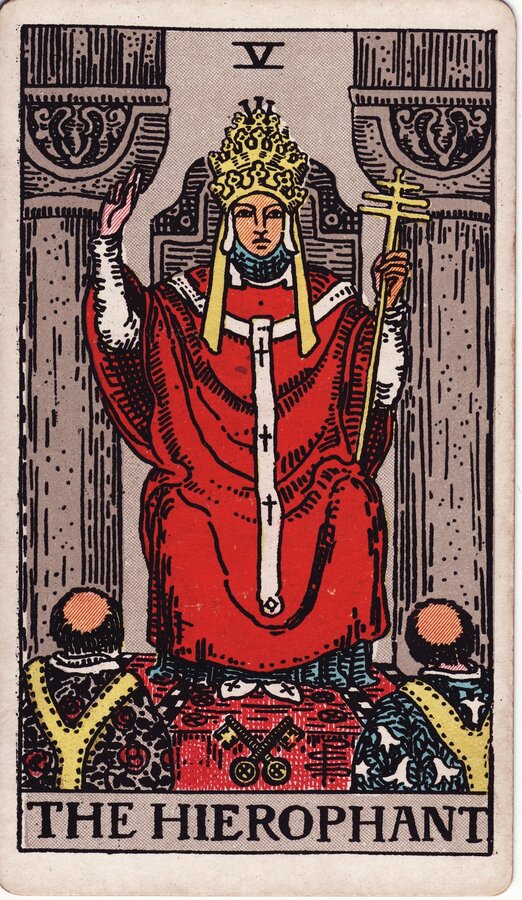
Where the Rider-Waite Hierophant speaks through architecture and ceremony — a throne, a staff, robed figures in a stone hall — Manara's version strips the scene to the body and the gaze. Manara's card typically centers on the physical encounter between a figure of authority and a supplicant: the power is intimate, personal, and shot through with desire rather than doctrine. In Waite-Smith, the transmission is vertical and impersonal, flowing from above through the Hierophant downward; in Manara, the same current runs between two people in close proximity, charged with sensation. The question the Waite card poses is: what teaching are you prepared to receive? Manara asks instead: what do you surrender when you open yourself to another's authority over you?
ManaraSoblazn — Sensual Tarot
SceneAn intimate, physical encounter between a figure of spiritual authority and a supplicant — personal, charged, the body presentA robed figure on a throne between stone pillars, two acolytes kneeling before him, keys at his feet — ceremony and hierarchy made visible
FocusThe erotic charge in the relationship between authority and surrender; how desire and doctrine entwineThe transmission of structured meaning from a tradition-bearer to those who receive it; sacred institutions as containers for wisdom
QuestionWhat do you give up — and what do you gain — when you yield to another's authority over your inner life?What teaching, lineage, or structure is holding something essential for you right now, and are you ready to receive it?
Symbolism & correspondences
The Hierophant is associated with Taurus, the fixed earth sign ruled by Venus — and this combination says more than it first appears to. Earth gives him substance: the tradition he carries is material, embodied, passed down through physical lineages of teachers and students. Fixed energy gives him duration: what he holds, he holds reliably, across seasons and generations. And Venus, surprisingly, gives him warmth — a reminder that the Hierophant at his best is not a bureaucrat but a loving keeper of something precious. On the Kabbalistic Tree of Life, the path of the Hierophant (Vav, the nail or hook) connects Chesed (loving-kindness, the expansive benevolence of a good king) to Chokmah (the first flash of wisdom). He is the hook that fastens divine wisdom to the world of human mercy — not a cold institution but a living clasp between above and below.
Element
Earth
♉
Astrology
Taurus (Venus-ruled earth; the fixed, enduring form that holds meaning in place)
✦
Arcana
Major
Ready to see how this card unfolds in your own reading?