RCANIKAUnlock your Arcana
0

Streak · 0 of 7 days

Come back every day — +1 ⭐ for logging in.

On your 7th day in a row+5 ⭐ and 30% off the subscription

Sign in to start your streak and earn ⭐

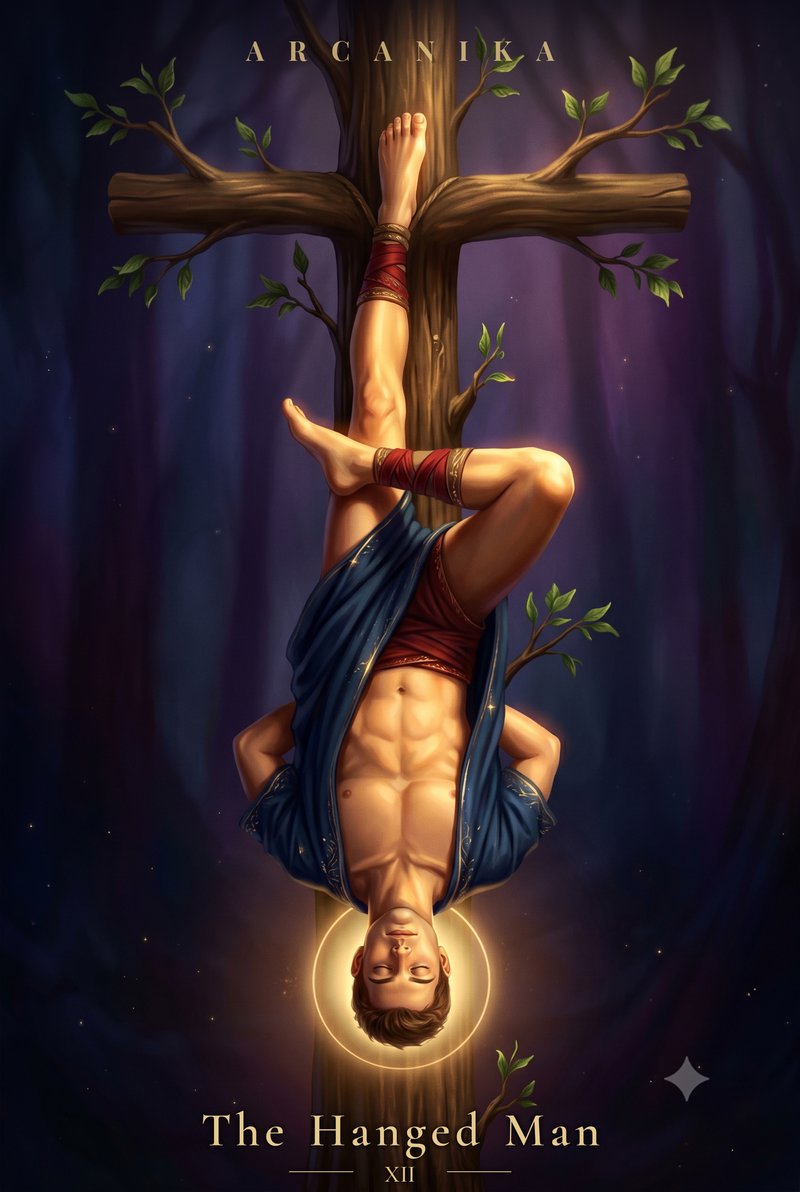
The Hanged Man — Tarot card, Soblazn — Sensual Tarot deck
Hover to explore

The Hanged Man

Soblazn — Sensual Tarot
surrendersuspensionnew perspectivevoluntary sacrifice

A sweet surrender. Let go of control, hang upside down — and the world will show itself from the side where everything is different.

The card's image

On a living tree-cross covered in fresh leaves hangs a young man with a bare torso, upside down; one leg is folded calmly behind the other in a "figure four," and a halo glows softly around his head. His face is not twisted with torment — it is almost blissful: he gave himself to this position of his own will, stopped struggling, and in stillness found a strange peace and clarity. Behind him a sunset sky burns down. The Hanged Man is about the pause, the sacrifice, the voluntary halt and the shift of perspective; about how sometimes you must hang and wait it out, give up power over a situation, in order to see it anew. In this surrender there is its own quiet eroticism — trust, a readiness to give oneself over, to stop clutching everything in a fist. The cast, inverted body is defenseless and calm at once. The card teaches: not everything is taken by force; sometimes the strongest move is to hold still between heaven and earth and let the world turn without you. What looks like helplessness from the outside feels, from within, like liberation. Stop fidgeting, let go — and you will see what cannot be made out while you cling to control.

Interpretation

There is a kind of wisdom that cannot be chased. The Hanged Man arrives at the exact midpoint of the Major Arcana's second act — after the outer world has been charted and the inner reckoning has begun — to say: stop here. Everything you have learned, everything you are carrying forward, must be turned upside down before it can become something true. This is not crisis. This is the pause between one way of being and the next, and it is necessary.

The Hanged Man carries in his body a profound kinship with The Fool and with The Hierophant. The Fool steps blithely off the cliff without looking; The Hanged Man has already gone over the edge — he is hanging there, head-down, and the view is extraordinary. The Hierophant teaches established wisdom, handing doctrine downward through the institution; The Hanged Man overturns all doctrine, finding revelation through personal surrender rather than received tradition. These three form an axis of initiation: naive trust, structured teaching, and finally — the dismantling of all frameworks in favour of direct experience.

✦ Full InterpretationUnlock the card's full readingFree registration reveals the final paragraphs of the interpretation and gifts you ⭐ for your first spreadyour first spread is on us

Advice & forecast

The card's advice

When this card appears, the most useful thing you can do is probably the thing that feels the least like doing: stop. Not the passive stop of giving up, but the active stop of someone who has chosen to listen instead of speak. Whatever decision is pressing, whatever urgency is building — it is asking you to act from incomplete information. The insight you need is already in motion; it just requires stillness to arrive. Trust that the pause is productive even when it looks like nothing. The halo on this figure's head is there for a reason: what is happening inside the suspension is sacred, even when the outside world sees only delay.

What the forecast holds

When The Hanged Man appears in the position of what is coming, expect a period of suspension rather than forward motion. Plans may stall, answers may not arrive on the schedule you hoped, and external progress may look slower than you'd like. This is not a bad omen — it is a necessary one. Something in the situation needs time to ripen that forcing cannot speed up. The forecast here is of a liminal passage: uncomfortable, quiet, and ultimately clarifying. What comes after this pause will be arrived at with a clarity that hurrying would have prevented. Do not mistake stillness for stagnation.

The Hanged Man reversed

Reversed, The Hanged Man has not escaped the position — he is still suspended, still inverted, still in the same impossible posture. What has changed is his relationship to it. Instead of the luminous acceptance of the upright figure, there is resistance: a writhing, a straining, an attempt to climb back up to right-side-up before the lesson has been absorbed. The energy that could have moved through him and transformed him is now bottled up in the effort to avoid transformation. This often manifests as a martyrdom that needs witnesses — suffering that is performed rather than endured privately, sacrifice that is announced rather than made quietly. There is a seduction in the story of being the one who gave everything; it can become an identity, a social position, a way of avoiding change by dramatising it instead. The reversed card also appears when delays are self-generated: procrastination disguised as waiting for a sign, indecision presented as patience. The question to ask yourself honestly is whether the pause still holds something — or whether you already know what you need to do and are simply afraid of what doing it will cost.

The card in spreads

The same card reads differently depending on the spread and the question — compare real spreads:

How it differs from Manara

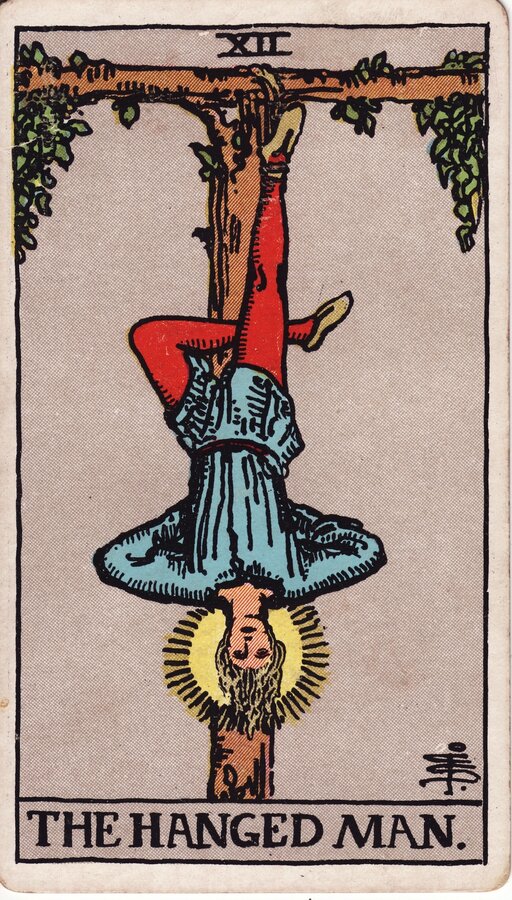
The Hanged Man — Rider-Waite-Smith deck
Rider-Waite-SmithThe Hanged Man
Soblazn — Sensual TarotThe Hanged Man

In the Rider-Waite-Smith deck, The Hanged Man is a study in willing suspension: a male figure, serene and haloed, in a posture that is recognisably initiatory rather than punitive. The scene is universal and archetypal, equally readable in questions of career, philosophy, or inner life. Milo Manara's erotic interpretation transforms the scene entirely: the figure is female, the suspension erotic and charged with desire, the focus shifted from transcendence to the body's vulnerability and longing. Where Waite's card asks 'what do you need to release to see clearly?', Manara's asks 'what does it feel like to surrender to another — to let go of self-possession entirely?' Both hold the same core truth about surrender, but they arrive at it through very different doors.

ManaraSoblazn — Sensual Tarot
SceneA woman suspended, the posture one of erotic vulnerability and surrender to another's gaze or touch — sensual, physically present, intimateA serene young man hangs upside down from a living timber, haloed, arms behind his back, expression peacefully interior
FocusThe body as the site of surrender — desire, vulnerability, the pleasure and danger of giving oneself overThe spirit as the site of surrender — initiation, inner transformation, the wisdom that only stillness can deliver
QuestionWhat does it mean to surrender yourself to another — to trust, to yield, to be held in someone else's power?What do you need to release, invert, or pause in order to receive the insight that urgency has been hiding from you?

Symbolism & correspondences

The Hanged Man is traditionally attributed to Neptune, the planet of dissolution, mysticism, and the breakdown of boundaries between self and everything else. Neptune dissolves the ego's hard edges, which is precisely what the card's archetype requires: you cannot receive the upside-down vision while still clinging to the right-side-up self. In the Kabbalistic system, the card corresponds to the Hebrew letter Mem, meaning water — and water is the element of depth, feeling, and the unconscious. The assigned path on the Tree of Life runs between Geburah and Hod, connecting severity to the sphere of thought: the card's deepest work happens when rational control (Hod) is willingly submitted to something larger and more demanding (Geburah).

Element
Water
Astrology
Neptune · Water · Hebrew letter Mem
Arcana
Major

Ready to see how this card unfolds in your own reading?

Make a reading

Your first reading is free · 30 seconds