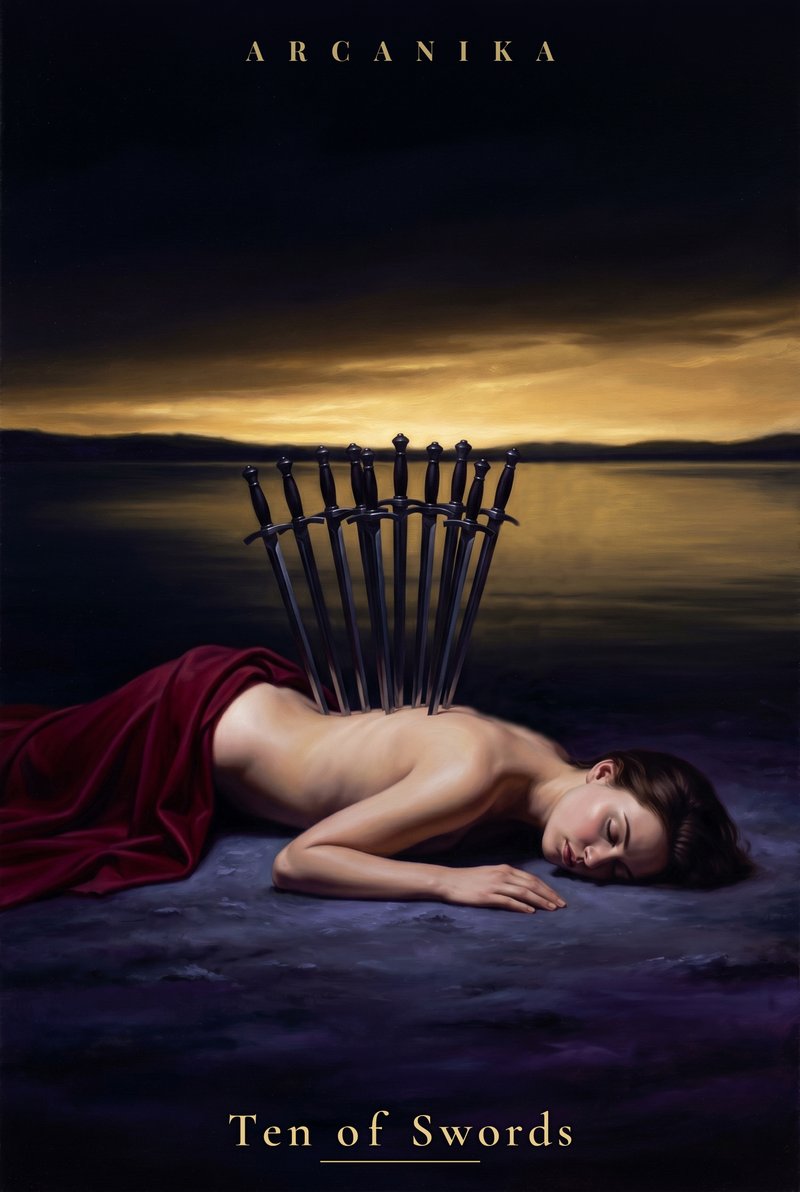
On a dark shore, face down, lies a nude woman, and into her back, along the spine, are driven ten swords — an image of total, final defeat; nearby, a cast-off cloth glows scarlet. And yet, at the very horizon, the first golden band of dawn is already breaking. The Ten of Swords — about the absolute limit, ruin, betrayal, an ending after which there is nowhere left to fall. This is the card of the bottom: everything has collapsed, the blow has landed, and to pretend something can still be saved is pointless. And still, ten swords are overkill, almost grotesque: it will not get worse, which means only one direction remains — up. The dawn behind the fallen woman — about the truth that any darkest night ends, and beyond the most bitter ending there is always a morning. The card speaks honestly: what has ended has ended completely; do not revive the corpse, do not cling to what is already finished. But precisely because you are at the very bottom, you are free — there is nothing more to lose, and you can finally rise and walk toward a new day. The end is also a beginning.
⚔️Ten swords in the back — Symbolic excess rather than literal wound — the mind has driven every possible blade of thought to its limit; no further suffering can be added to this count
🌅Narrow band of dawn — A statement of fact rather than consolation — the sun rises regardless of the darkness, and this light cannot be argued away
🌊Still water on the horizon — Transition and passage; the threshold between what has ended and what has not yet begun
🙏Blessing gesture of the right hand — Even at the lowest point, something in the human spirit orients toward continuation; the hand blesses the ground it lies on
🩸Crimson cloth beneath the body — Life-force still present beneath the stillness — blood and vitality have not vanished, only gone quiet
🌑Black sky — The full weight of accumulated thought and grief pressed to its ceiling; darkness at maximum density, which is why it must now begin to lift
Interpretation
The Ten of Swords embodies a truth that is hard to hold and harder still to receive as a gift: suffering has a natural ceiling. The mind that has tormented itself — with overthinking, with betrayal, with the slow erosion of a dream — eventually reaches a point of absolute saturation. No new wound can be added to ten already planted. This is the card of rock bottom understood not as punishment but as completion, and completion always contains within it the seed of a new beginning.
Within the arc of the Swords suit, the Ten stands as the final station of a long journey through intellect, conflict, and pain. It follows the sleepless anguish of Nine of Swords, where the mind tortures itself in the dark, and precedes the fresh potential of the Page of Swords, who moves through the world with unencumbered curiosity. The Ten is what happens between those two states: everything that needed to end has ended, and the slate is swept bare. Its kinship with Death is significant — both cards speak of transformation through finality, though where Death transforms the form, the Ten exhausts the experience entirely.
In a reading, this card often brings an odd relief alongside its obvious gravity. Clients who have been dreading 'the worst' sometimes find that when the Ten appears, the worst is already behind them — the relationship ended, the job was lost, the illusion shattered. The card names what is already true. In the position of advice, it counsels radical non-resistance: stop trying to hold together what the swords have already claimed. In the position of outcome, it promises closure of a particularly thorough kind.
Placed alongside Ace of Wands or Ace of Cups, the Ten of Swords announces a powerful pivot — one suit's ending is another's beginning, and the depletion of Swords energy creates the exact space needed for Wands fire or Cups feeling to rush in. Near The Tower, it deepens the sense of complete structural collapse; but near The Star, the dawn on its horizon becomes a promise rather than a whisper.
✦ Full InterpretationUnlock the card's full readingFree registration reveals the final paragraphs of the interpretation and gifts you ⭐ for your first spreadyour first spread is on us
Advice & forecast
✦ The card's advice
Do not look for a way to soften this ending or delay it — the swords are already in, and the scene is already complete. What you are being asked to do now is to lie still for a moment and notice the light on the horizon before you stand. The temptation will be to rise immediately, to rebuild, to prove that you are fine; resist it long enough to let the grief be real. Everything that needed to end has ended, which means you are no longer carrying it. That is a kind of freedom, even if it does not feel like one yet. The next chapter will not begin from the same ground that broke you — it begins from the cleared earth after the swords have fallen away.
🔮 What the forecast holds
Something that has been slowly coming to its end will now reach it — and the completion will be more thorough than you expected, perhaps even more public. There may be a sense of betrayal or abruptness about how it closes, but the roots of this ending go further back than the final moment. What follows this conclusion is genuine: a real opening, not a false one, because the ground will have been fully cleared. Do not rush to fill the emptiness that comes after. The light that appears on your horizon in the weeks ahead is not an illusion — it is the natural consequence of having reached the bottom and found it solid.
↓ Ten of Swords reversed
Reversed, the Ten of Swords asks whether you are resisting a closure that is already ordained. The swords are loosening — they want to fall away — but something in you is gripping the wound, replaying the betrayal, or insisting that the story is not yet over when it plainly is. There is also a more tender reading here: recovery is genuinely underway, and the dawn that was only a sliver upright has grown a little wider. Either way, the reversed card carries instability — whatever is gained or regained now will need careful tending, because it has been won from a very low place. In its shadow form, this card can indicate a refusal to acknowledge how thoroughly something failed, a grasping after the shape of what was destroyed rather than allowing a genuinely new thing to take root. The real work of the reversal is honest acknowledgment: touch the bottom, name it, and then — only then — begin to rise.
The card in spreads
The same card reads differently depending on the spread and the question — compare real spreads:
Spread "The Threshold Spread"
Understanding a major ending and what it opens
«What has just ended, why was it necessary, and what does it make room for?»
What was already over (the wound before the wound)
Nine of Swords
The ending itself — what has now been completed
Ten of Swords
The spark that becomes possible once this chapter closes
Ace of Wands
When the Ten of Swords falls in the central position of this spread, it names the ending with precision — something has run its full course and cannot be extended. Read Nine of Swords in the first position as the period of dread and sleeplessness that preceded this conclusion: the suffering had been building for longer than the final moment suggests. The Ace of Wands in the third position carries particular power here — it shows that what the clearing makes room for is genuinely new fire, not a patched version of what was lost. The conversation between all three cards is about the courage to let an exhausted thing exhaust itself, trusting that the depletion is the precondition, not the punishment.
Spread "The Dawn Spread"
Finding the way forward after hitting rock bottom
«I have reached the lowest point — what do I carry forward, what do I leave, and where does the path begin?»
The bottom — what has been fully completed and can be set down
Ten of Swords
Rest and restoration — what the recovery actually requires
Four of Swords
The guiding light — what the horizon holds
The Star
The Ten of Swords in the first position is an honest witness to where you are: the cycle is done, the struggle is over, and you are lying on the ground. This is not dramatic license — it is permission to stop fighting. Four of Swords in the second position speaks directly to what recovery demands: not action, not rebuilding, but genuine rest and withdrawal from all the noise that preceded the fall. There is medicine in that card's stillness that the Ten has earned you access to. The Star as the third card is one of the most generous companions the Ten of Swords can receive — it confirms that the hope visible on the card's horizon is real, that healing is not wishful thinking but the natural arc after this depth of depletion. Read the spread as a journey in three beats: acknowledge the ending, honour the rest, trust the light.
✦ PremiumUnlock the Full ReadingSpread "The Dawn Spread": position-by-position reading, card combinations, and guidanceOpen with subscription →first spread is free
Spread "The Betrayal Spread"
Processing a painful ending that felt like a betrayal
«Was I truly betrayed, what is my part in this, and how do I move without carrying the wound?»
The wound — what was actually pierced or broken
Three of Swords
The ending — what this experience has now completed in you
Ten of Swords
What fairness or truth looks like from outside the pain
Justice
What the heart needs now in order to begin again
Ace of Cups
The Three of Swords in the first position names the grief at its source — heartbreak, loss, the sharp entry of reality into something you believed in. The Ten of Swords in the second position confirms that this pain has now run its full course: you have not merely been hurt, you have been changed, and the chapter that contained that version of the story is closed. Justice as the third card is a useful corrective — it asks you to look at the situation as a whole, without the distorting lens of betrayal. Sometimes Justice confirms the wound was real; sometimes it shows that what felt like betrayal was an honest ending that hurt. Ace of Cups in the final position points toward what genuinely heals: not resolution of the story, not explanation from the person who hurt you, but the reopening of your own capacity to feel, to receive, to begin fresh from the emotional ground that the swords have, paradoxically, cleared.
✦ PremiumUnlock the Full ReadingSpread "The Betrayal Spread": position-by-position reading, card combinations, and guidanceOpen with subscription →first spread is free
How it differs from Manara
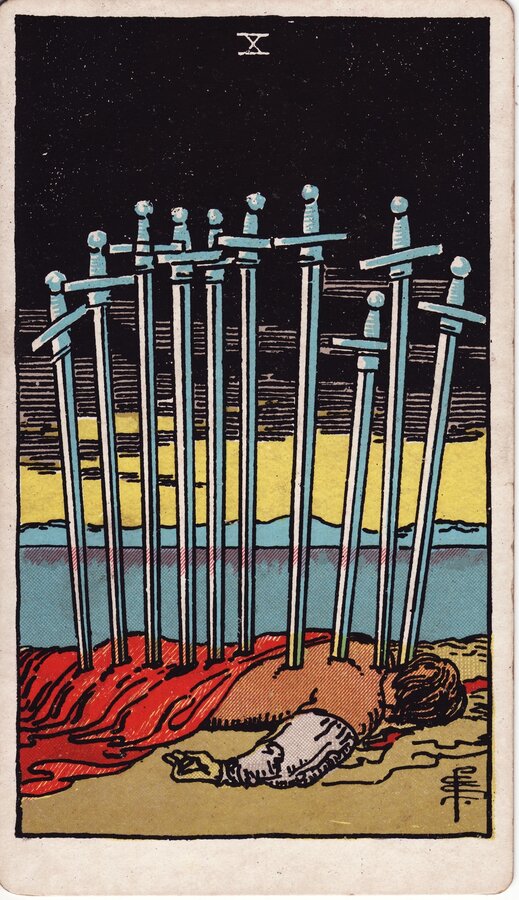
Rider-Waite-SmithTen of Swords
vs
Soblazn — Sensual TarotTen of Swords
In Milo Manara's Erotic Tarot, the Ten of Swords is rendered through the body's vulnerability and desire — the figure is not simply defeated but exposed, and the swords become an almost intimate intrusion, charged with the sensuality that runs through the entire Manara deck. The scene invites the viewer to feel the penetration of experience rather than merely witness it. The Rider-Waite-Smith version, by contrast, holds clinical distance: the figure is fully clothed, the swords a symbolic count, and the emphasis falls on the archetypal pattern of a cycle concluded. Where Manara asks 'what does it feel like to be pierced by every experience you have invited?', Waite asks 'what remains when a chapter has exhausted every possibility?'. Manara focuses inward on sensation and surrender; Waite looks outward toward the dawn and the pattern of endings.
ManaraSoblazn — Sensual Tarot
SceneA vulnerable, exposed figure — swords as intimate intrusion; sensual surrender and the body as the site of all experienceA clothed figure face-down, ten swords in symbolic excess; ceremonial stillness, water and dawn as witness
FocusThe felt texture of defeat — what it means to be entirely open and pierced by every experience one has allowed inThe archetypal pattern of an ending — the cycle's terminus, the law that pain exhausts itself, the inevitability of dawn
QuestionWhat does it cost to be fully present to everything life drives through you?What happens when a chapter has run completely out of road — and what does the light on the horizon mean for you now?
Symbolism & correspondences
The Ten of Swords corresponds to the Sun in Gemini, the final decan of an air sign ruled by the solar principle of clarity and completion. Gemini's double nature is here pushed to its absolute limit — every thought, every perspective, every mental thread has been pursued until it can go no further, and the result is the overload symbolised by ten blades. The Sun's presence in this decan is not warming but illuminating: it shows the scene in full light, without mercy and without embellishment. This astrological pairing reinforces the card's core teaching — that the mind, when it has exhausted its own possibilities, finally becomes still enough to see the dawn it has been too busy suffering to notice.
Element
Air
◆
Arcana
Minor
Suit
Swords
Ready to see how this card unfolds in your own reading?