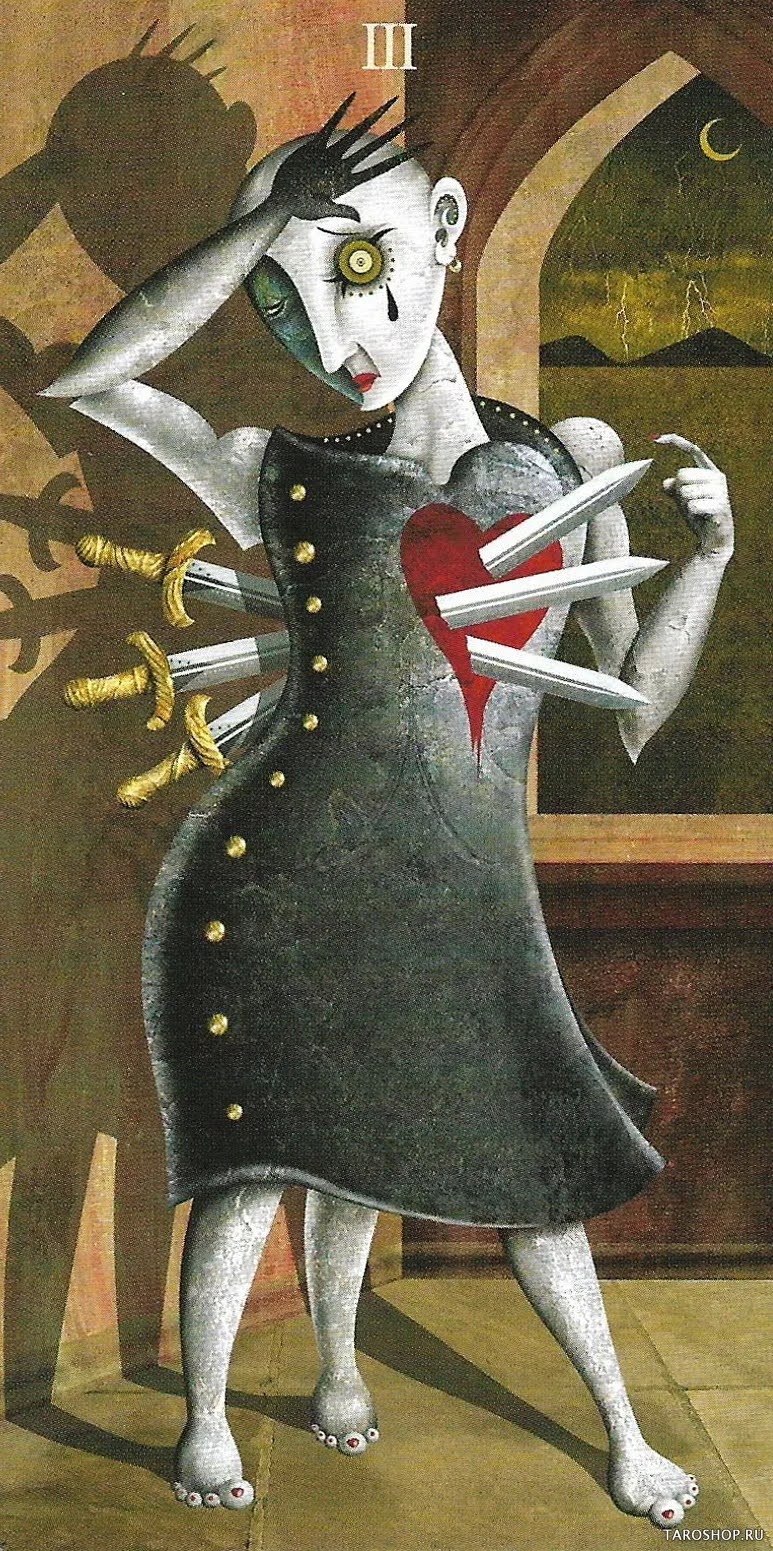
A grieving woman is alone in her chamber while a storm gathers in the distance. Her heart is pierced by betrayal — and she touches the point of the blade, testing whether the pain is real.
A sad woman stands alone in her room while a fearsome storm bears down in the distance. Her heart has been pierced by an act of betrayal. She touches the tip of one of the swords, as if trying to grasp whether the pain she feels is real or only imagined. The lightning and clouds beyond the window echo what is happening within: the wound outside, the foul weather outside, and nowhere quiet.
💔A pierced heart — the direct pain of betrayal; a wound dealt by someone close
🌩️An approaching storm — a state without prospect; the whole sky weeps with her
🤚Touching the point — testing the reality of the pain; an attempt to grasp whether it was imagined
🚪Solitude in the chamber — separation, longing for an absent love; no one near
Interpretation
The Three of Swords here is the most direct card of pain in the whole deck. A woman alone in a room, her heart pierced by betrayal, touching the blade and unable to believe it is true. Outside, a storm gathers — the world weeps with her. This is suffering without ornament or metaphor: separation, infidelity, loss.
In Waite's tradition, the image symbolizes its meaning so plainly that it needs no decoding. This is a stroke that pierces all defenses: the betrayal of someone close, a lover gone, news after which life cannot continue as before. Removal, absence, delay. The pain is pure, untangled, without guilt or hidden depth — it simply hurts, and that must be acknowledged.
Upright — a broken heart, separation, a stormy relationship, longing for an absent love. Paradoxically, there is dignity in this nakedness: the heart is pierced, but it is visible. Unlike the closed dread of the Nine Nine of Swords or the trap of the Eight Eight of Swords, the Three is a wound dealt from outside, and it can be named.
With The Tower The Tower the Three shares the collapse of what seemed solid: The Tower brings down a structure, the Three a bond. And The Lovers The Lovers are its reverse side: somewhere someone made a choice not in our favor, and hence the three blades in the heart.
The card's counsel is to let the heart hurt. Do not tangle clear pain with analysis, do not try to decide whether it is real, like the heroine touching the point — it is real. This is suffering that can be lived through and that can be left behind, unlike the closed wounds of the suit. After the wound comes the retreat into the peace of the Four Four of Swords.
✦ Full InterpretationUnlock the card's full readingFree registration reveals the final paragraphs of the interpretation and gifts you ⭐ for your first spreadyour first spread is on us
Advice & forecast
✦ The card's advice
Allow yourself to hurt, and do not pretend the blow can be softened or explained away. The heart is pierced — that is a fact, and the only honest path now is not to analyze the wound but to live through it. Do not touch the point again and again, testing whether the pain is real: you know that it is. Call what happened by its name — infidelity, separation, loss — and let yourself mourn. There is dignity in this open pain, and there is a way out: a pierced heart is visible, and so it can be healed. The closed wounds of the suit are far more dangerous than this honest one.
🔮 What the forecast holds
Ahead lies a blow to the heart: separation, disillusionment, betrayal, or news after which life cannot continue as before. The pain will come pure and direct, with no hidden depth, and at first it will be hard to believe. But this wound, unlike the closed sufferings of the suit, is honest and can be named — it can be lived through and left behind. The storm will pass, and after the Three comes the Four: retreat, silence, healing. First the hurt, then the peace.
↓ Three of Swords reversed
The reversed Three of Swords here heightens grief to its limit: extreme sorrow, the loss of a loved one, emotional torment. If the upright card is a wound that can be lived through, the reversed one is grief that loses its clarity and drags on. The mind fusses around the wound, never letting it heal; the pain scatters, tangles, hardens into a trait of character. An old wound is reopened through the return of the past, through meeting the one you wounded or who wounded you. In a milder reading, the swords begin slowly to be drawn out, and recovery is possible. In a heavier one — the wound becomes chronic, turns into an identity, and the person can no longer imagine themselves without their pain.
The card in spreads
The same card reads differently depending on the spread and the question — compare real spreads:
Spread "Surviving the breakup"
Find footing after the blow
«How do I cope with this pain?»
The wound
Three of Swords
What is needed now
Four of Swords
The way forward
Six of Swords
The Three of Swords — the wound is named: separation, betrayal, a broken heart; the pain is real, and it must be acknowledged. What is needed now Four of Swords is the Four of Swords: a retreat into silence, peace, healing; do not act, let yourself lie down and fall quiet. The way forward Six of Swords is the Six of Swords: a crossing from the storm toward calmer shores, a slow movement away from acute pain. First live the wound openly, then retreat, then sail away. Do not tangle clear pain with analysis — this is suffering one comes out of.
Spread "What happened between us"
Understand the nature of the rupture
«Why did it end so painfully?»
What happened
Three of Swords
Root
The Lovers
The finale
Ten of Swords
The Three of Swords in the present — the heart is pierced by betrayal or separation, the blow dealt from outside and landing exactly. The root The Lovers is The Lovers in their reverse side: somewhere a choice was made not in your favor, and hence the three blades in the chest. The finale Ten of Swords is the Ten of Swords: what caused the pain has used up its resource; this is the bottom after which there is only dawn. The bond has ended for good — but precisely because it can get no worse, things will grow easier from here.
✦ PremiumUnlock the Full ReadingSpread "What happened between us": position-by-position reading, card combinations, and guidanceOpen with subscription →first spread is free
Spread "The Lesser Cross"
Clarify the essence and outcome of the sorrow
«What should I do with this grief?»
Essence
Three of Swords
What I fear
Nine of Swords
Hope
The Star
The Three of Swords at the essence — an open wound of the heart, the honest pain of separation or betrayal. I fear Nine of Swords the Nine of Swords: that the pain will turn from clear into a nocturnal dread, into sleeplessness, into a mind tormenting itself. This is the risk of the reversed Three — grief become a trait of character. Hope The Star is The Star: healing, a quiet light after the storm, the faith that the wound will close. Do not let clear pain slip into closed dread: mourn it openly, and then after the storm The Star will rise.
✦ PremiumUnlock the Full ReadingSpread "The Lesser Cross": position-by-position reading, card combinations, and guidanceOpen with subscription →first spread is free
How it differs from Waite
Rider-Waite-SmithThree of Swords
vs
Deviant Moon TarotThree of Swords
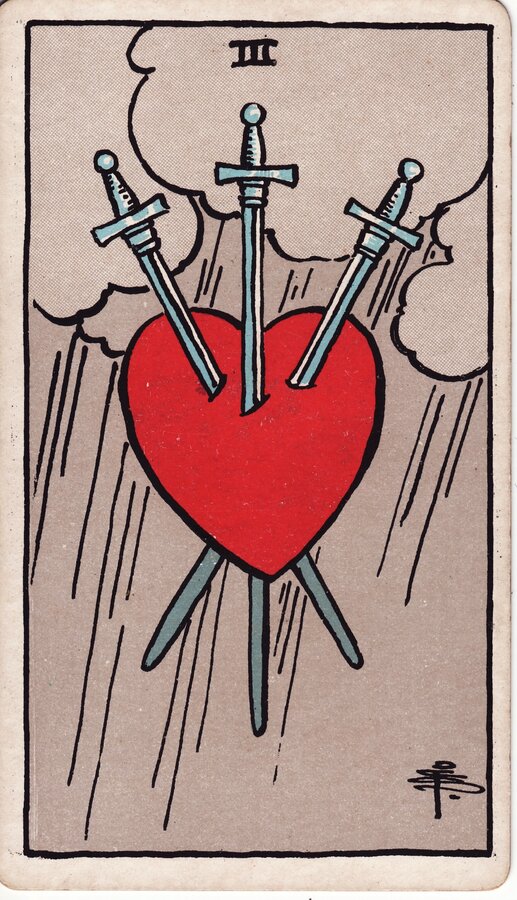
In Waite, the Three of Swords is utterly spare: three swords piercing a stylized heart against the rain — the pure archetype of pain, without face or story. This deck gives the heart back its owner: a grieving woman in a room who touches the point, testing the reality of her wound. This makes the pain personal and psychological — adding the motif of doubt, of numbness, of disbelief in what has happened, which is absent from Waite's cold heraldry. Both are about the same thing: separation, betrayal, a broken heart. But Waite shows the wound as a fact of the world, this deck as an experience still hard to believe.
WaiteDeviant Moon Tarot
SceneThree swords pierce a heart under a gray rain.A woman in her chamber touches the point, a storm beyond the window.
AboutRupture, separation, disillusionment, pure pain.A broken heart, infidelity, longing for an absent love.
TellingAn impersonal archetype, the wound a fact without an owner.A personal experience, disbelief, the testing of the pain's reality.
Symbolism & correspondences
Saturn in Libra: Saturn (heaviness, limitation, inexorability) in Libra (relationships, unions) — grief in love, the rupture of a bond, sorrow laid upon the sphere of partnership. The harshest combination of the airy decade: the storm beyond this deck's window is a Saturnine cold descended upon the heart.
Element
Air
◆
Arcana
Minor
Suit
Swords
Ready to see how this card unfolds in your own reading?